The Neuronics Conference 2026 took place at the Yonsei University, Seoul, from the 8th to the 10th of September 2026.
Organizers
Valeria Bragaglia
Seyoung Kim
Kyung Min Kim
Wooyoung Shim
Conference Manager
Irene Foz
NEURONICS26 Conference Manager
Inés Maderna
Conference Manager Onsite
Keynote Speakers
Cheol Seong Hwang
Jeehwan Kim
Professor Kim joined the Department of Mechanical Engineering faculty in 2015 and DMSE as a joint faculty member in 2016. Before MIT, he was a research staff member at IBM’s Thomas J. Watson Research Center, conducting research in photovoltaics, 2D materials, graphene, and advanced complementary metal-oxide semiconductor devices. Professor Kim has been named a Master Inventor at IBM, with more than 100 patent filings in five years. He received a BS from Hongik University in Seoul, South Korea, an MS from Seoul National University, and a PhD from the University of California, Los Angeles, all in materials science and engineering.
Mario Lanza
Dr. Mario Lanza is an Associate Professor of Materials Science and Engineering at the National University of Singapore, since August 2024. He got the PhD in Electronic Engineering in 2010 at the Autonomous University of Barcelona, where he won the extraordinary PhD prize. In 2010-2011 he was NSFC postdoctoral fellow at Peking University, and in 2012-2013 he was Marie Curie postdoctoral fellow at Stanford University. On September 2013 he joined Soochow University (in China), where he promoted until the rank of Full Professor. Between October 2020 and July 2024 he was full-time Associate Professor at the King Abdullah University of Science and Technology (in Saudi Arabia), where he became known for his work in the field of nano-electronics. He has published over 250 research articles in top journals like Nature (3), Science (2), and Nature Electronics (8), many of them becoming highly cited. He has been plenary, keynote, tutorial and invited speaker in over 150 conferences, and he and his students have received some of the most prestigious awards in the world (like the IEEE Fellow). He has been often consulted by leading semiconductor companies and publishers. He is an active member of the board governors of the IEEE – Electron Devices Society, and has been involved in the technical and management committee of top conferences in the field of electron devices, including IEDM, IRPS and IPFA. He speaks fluently five languages: English, Chinese, German, Spanish and Catalan.
Insoo Yoon
Invited Speakers
Yuta Aiba
Yuta Aiba is a researcher at KIOXIA Corporation, Yokohama 247-8585, Japan. He joined Toshiba Corporation in 2016. Aiba has a MS in physics from the Tokyo Institute of Technology, Tokyo, Japan. His current research interests include 3D flash memory and machine learning.
Emanuel Carlos
Currently, Emanuel Carlos is a Research group leader of Flexible and Sustainable Electronics at CENIMAT|i3N, Local PI of TRANSPER, INNOVATION, LEAF, MORPHEUS and ELEGANCE (international level), co-PI of one project at national (SECURE) and other at international level (GAIA). He finished his PhD in 2021 in Nanotechnologies and Nanosciences, NOVA University Lisbon. He has been working in solution-based metal oxide electronics since 2015, focusing on sustainable materials and printing technologies (inkjet, flexographic and screen printing) for electronic devices. His work involves the design, deposition, and characterization of solution-based metal oxide thin films and 2D materials, fabrication, and characterization of electronic devices (memristors, microsupercapacitors, TFTs and sensors). He is co-author of > 40 peer-reviewed papers in high-impact journals and 4 book chapters in this area. He is also currently involved in other international (POEMS and INFRACHIP) research projects.
Alwin Daus
Prof. Dr. Alwin Daus obtained his Dr. sc. degree (2018) in the field of flexible electronics from ETH Zürich and his B.Sc./M.Sc. in electrical engineering from TU Braunschweig. During his studies, he did research stays and internships at Princeton University (surface chemistry), Robert Bosch LLC (micro-electromechanical systems) and Philips Technologie GmbH (organic light-emitting devices).
After his doctoral degree, he received the Early Postdoc.Mobility Fellowship from the Swiss National Science Foundation and joined Stanford University. During his postdoc, he studied electronic devices based on 2D materials, chalcogenides and oxide semiconductors including transistors, memory, solar cells and sensors. In 2021 he was awarded the AVS Nanoscale Science and Technology Division Early Career Award. He then joined RWTH Aachen University where he led activities on 2D material-based memristive devices for neuromorphic computing. In 2022 he became recipient of the Emmy Noether Programme by the German Research Foundation and established his independent research group. In 2023 he was then appointed Tenure-Track-Professor at University of Freiburg. In October 2024, he became full professor at University of Stuttgart heading the Institute of Semiconductor Engineering. His current research interests span over a wide range of materials such as chalcogenides, oxides and group IV alloy semiconductors, and he works on electronic and optoelectronic devices for back-end-of-line integration, flexible electronics and photonics.
Marco Fanciulli
Marco Fanciulli (Full professor). Marco Fanciulli was born in Imperia, Italy in 1961. He received cum Laude the Laurea degree in Nuclear Engineering from the Politecnico di Torino, Italy in 1987 and “with distinction” the Ph.D. in Applied Physics from Boston University (USA) in 1993 under the supervision of Prof. T.D. Moustakas, defending a thesis on the Study of wide-band-gap semiconductors using magnetic resonance spectroscopies. From 1993 till 1997 he was Post-Doc at the University of Aarhus where in 1997 he was appointed Associate Professor. In 1998 he was hired as first researcher by the Italian Institute for condensed matter physics (INFM) to set up a new Laboratory inside STMicroelectronics, the MDM Lab. In 2001 he got the Director of Research position at INFM. In 2007 he joined as Full Professor the Department of Material Science at the University of Milano Bicocca while maintaining the leadership of the MDM Lab. till 2015. In March 2025 he joined the Department of Chemistry of the University of Torino. He has published 427 papers and edited 2 books (Scopus September 2024: H-index 50, 12498 citations). He has organized several international symposia (E-MRS, MRS) and two international workshops on Unconventional Computing (WUC) and has been invited to 42 international conferences. He has coordinated or participated several EC, international, national, and industrial projects. For outstanding contributions in the growth and characterization of materials and nanostructures for emerging devices for information processing in 2015 he was nominated Fellow of the American Physical Society. He has contributed to the development of nanoelectronics devices: materials and processes for ultra-scaled nanoelectronics devices and for innovative non-volatile memories (high-k dielectrics, silicides, low-k), single atom electronics, silicon nanostructures (silicon nanowires, quantum dots, 2D-materials); spintronics: magnetic tunnel junctions, donors in silicon for classical unconvetional computing and quantum information processing, and neuroelectronics (EOSC devices and materials for micro- and nano-electrode arrays).
Liza Herrera Diez
Liza Herrera Diez is a CNRS research director at the Centre for Nanoscience and Nanotechnology in Palaiseau, France. She studied physical chemistry at the National University of Córdoba in Argentina and conducted her PhD work at the Max Planck Institute for Solid State Research in Germany while enrolled in the physics doctoral school at Ecole Polytechnique Fédérale de Lausanne.
She has an interdisciplinary background in physics and chemistry. Her research focuses on magneto-ionics, which combines the analogue functionality of ionics with the binary nature of magnetism to develop reconfigurable multistate spintronic nanodevices. She coordinated the MSCA Innovative Training Network MagnEFi on electric-field effects in magnetic materials and devices, and currently coordinates the EU Pathfinder project METASPIN, which explores magneto-ionic approaches to design multifunctional nanodevices for neuromorphic hardware.
Erbing Hua
Dr. Erbing Hua is a Researcher at QuTech, TU Delft. His research focuses on low-power memristors, compute-in-memory systems, cryogenic electronics, and scalable quantum control hardware for next-generation information processing.
Yoon Ho Jang
I am an Assistant Professor in the Department of Materials Science and Engineering at Yonsei University. My academic journey began at Seoul National University, where I completed both my B.S. and integrated Ph.D. program, followed by postdoctoral training at the Inter-University Semiconductor Research Center (SNU) and Harvard University. Driven by the vision of brain-inspired intelligence, my research group focuses on developing next-generation neuromorphic computing hardware utilizing advanced memory devices, and crossbar arrays to accelerate AI workloads and graph data. Currently, at Yonsei University, I am committed to pioneering innovative semiconductor technologies while mentoring the next generation of engineers.
Asif Khan
Sangbum Kim
Sangbum Kim is an associate professor in the Department of Materials Science and Engineering at Seoul National University. From 2010 to 2018, he was with the IBM T.J. Watson Research Center in New York, USA. He is currently working on novel semiconductor materials and devices for various memory applications, including analog compute-in-memory, brain-inspired neuromorphic computing, storage-class memory, and embedded memory, with a particular focus on device-algorithm co-optimization for analog compute-in-memory. He has served as a subcommittee chair for leading international semiconductor device conferences, including the 2023 International Reliability Physics Symposium (IRPS) and the International Electron Devices Meeting (IEDM) from 2022 to 2026. He also served as finance, technical program, and general chair for IMW from 2024 to 2026. He received his B.S. degree from Seoul National University, Seoul, Korea, in 2001, and his M.S. and Ph.D. degrees in electrical engineering from Stanford University, Stanford, California, in 2005 and 2010, respectively. His Ph.D. dissertation focused on the scalability and reliability of phase change memory (PCM).
Gwangmin Kim
Jimin Lee
Takashi Tsuchiya
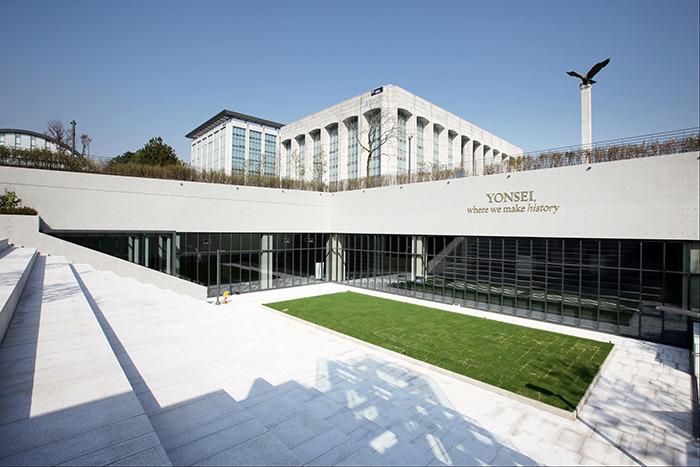
Venue
Conference venue
The Commons, Building 130, Yonsei University.Building 130, YoBaekyang-Nuri (The Commons), Yonsei University, 50 Yonsei-ro, Seodaemun-gu, Seoul 03722, Koreansei University
Sponsors
The conference took place at the Yonsei University in the city of Seoul, South Korea.
Address: 50 Yonsei-ro, Seodaemun-gu, Seoul, South Korea